
Otto Brooks · 1 November 2026
Warsaw Event Examines Recycling Routes for Solar Panels as Waste Levels Climb
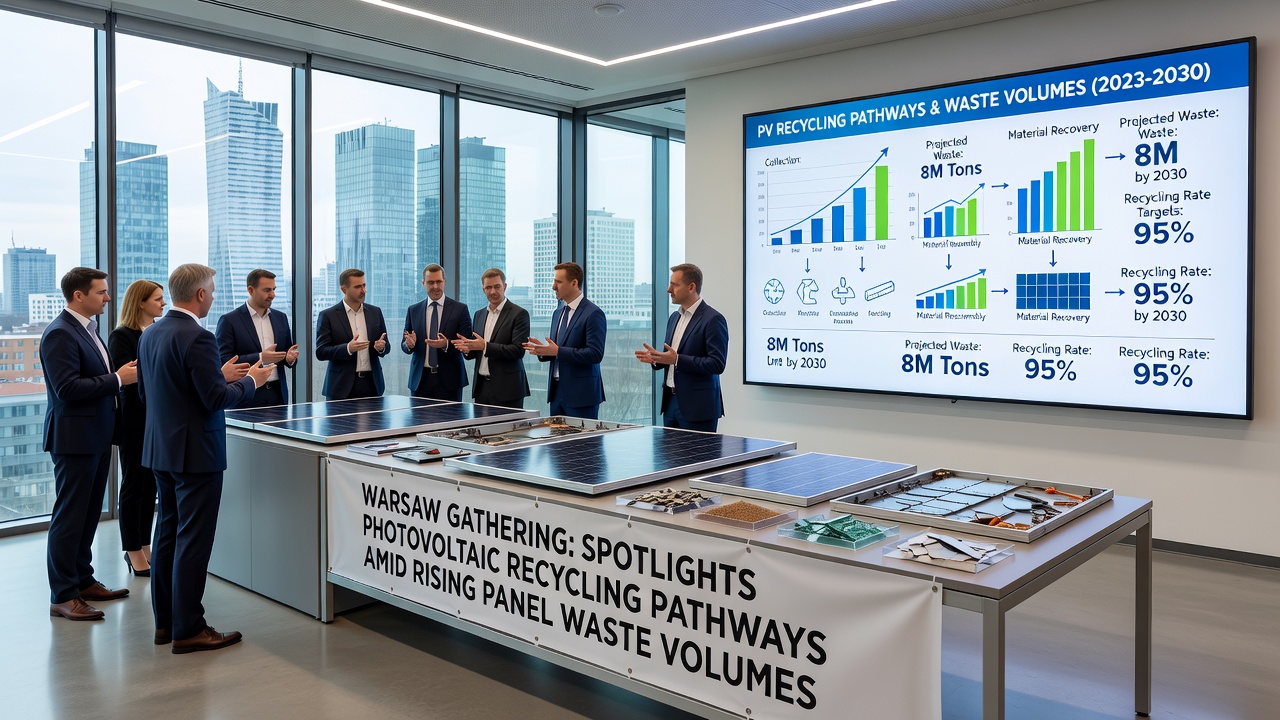
European specialists gathered in Warsaw during November 2026 to map out recycling routes for photovoltaic panels while waste volumes from early installations continue to increase across the continent. The two-day meeting brought together researchers, manufacturers, and policy advisors who reviewed current collection systems and emerging recovery technologies designed to handle the growing stream of end-of-life modules.
Scale of the Challenge Emerges from Deployment Data
Installation records show that Europe added more than 200 gigawatts of solar capacity between 2010 and 2020, and many of those panels now approach the end of their 25-to-30-year service life. Figures released by the European Commission indicate that annual photovoltaic waste could reach 1.5 million tonnes by 2030, with Poland among the countries expected to see the sharpest rise because of recent large-scale rooftop programs. Observers note that silicon, silver, and glass constitute the bulk of recoverable materials, yet current collection rates remain below 20 percent in several member states.
Technical Pathways Presented at the Sessions
Presentations covered mechanical crushing followed by chemical leaching, thermal delamination processes that separate glass from semiconductor layers, and newer hydrometallurgical methods that recover high-purity silicon at lower energy inputs. One research group from Germany demonstrated a pilot line that extracts 95 percent of the silver content while reusing the aluminum frame in new modules. Polish participants described a regional pilot that combines panel collection with existing electronic waste facilities, reducing transport distances and lowering overall processing costs.
Attendees examined how automated sorting systems using near-infrared spectroscopy could improve the speed and accuracy of material identification at recycling plants. Data from an Australian Renewable Energy Agency study shared during the event showed that such systems cut labor requirements by nearly 40 percent compared with manual separation.
Policy Frameworks and Producer Responsibility
Discussions turned to the revised Waste Electrical and Electronic Equipment Directive, which now includes explicit targets for photovoltaic waste recovery. National representatives outlined how extended producer responsibility schemes could shift collection and treatment costs back to manufacturers, creating incentives for design changes that simplify disassembly. A representative from the U.S. National Renewable Energy Laboratory presented findings on voluntary take-back programs operating in several American states, noting that participation rates improved when financial deposits were collected at the point of sale.
Regional Case Studies and Pilot Projects
One study revealed that a Dutch consortium recovered 80 percent of panel mass through a combination of glass reuse in construction aggregates and metal smelting, while another project in Spain focused on refurbishing functional modules for secondary markets in Eastern Europe. Polish technical universities reported early results from a joint program that trains technicians to perform on-site diagnostics, allowing early identification of modules suitable for repair rather than immediate recycling.
Participants also reviewed logistics models that coordinate reverse supply chains between installers and certified recyclers. These models rely on digital tracking tags embedded in new panels, enabling traceability from factory gate to end-of-life processing. Researchers from Sweden presented lifecycle assessments showing that closed-loop recycling could reduce the carbon footprint of new panel production by up to 30 percent when high-quality materials return to the supply chain.
Conclusion
The Warsaw gathering concluded with a set of recommended actions that include harmonized collection targets across member states, expanded research funding for advanced separation technologies, and public awareness campaigns to increase household participation in take-back schemes. Follow-up meetings are scheduled for 2027 in two additional European capitals to track implementation progress and share updated performance data from ongoing pilot facilities.