Ines Neumann · 6 September 2026
Student-Built Solar Trackers and Agrivoltaic Trials Shift Community Energy Models Across Polish Farmland
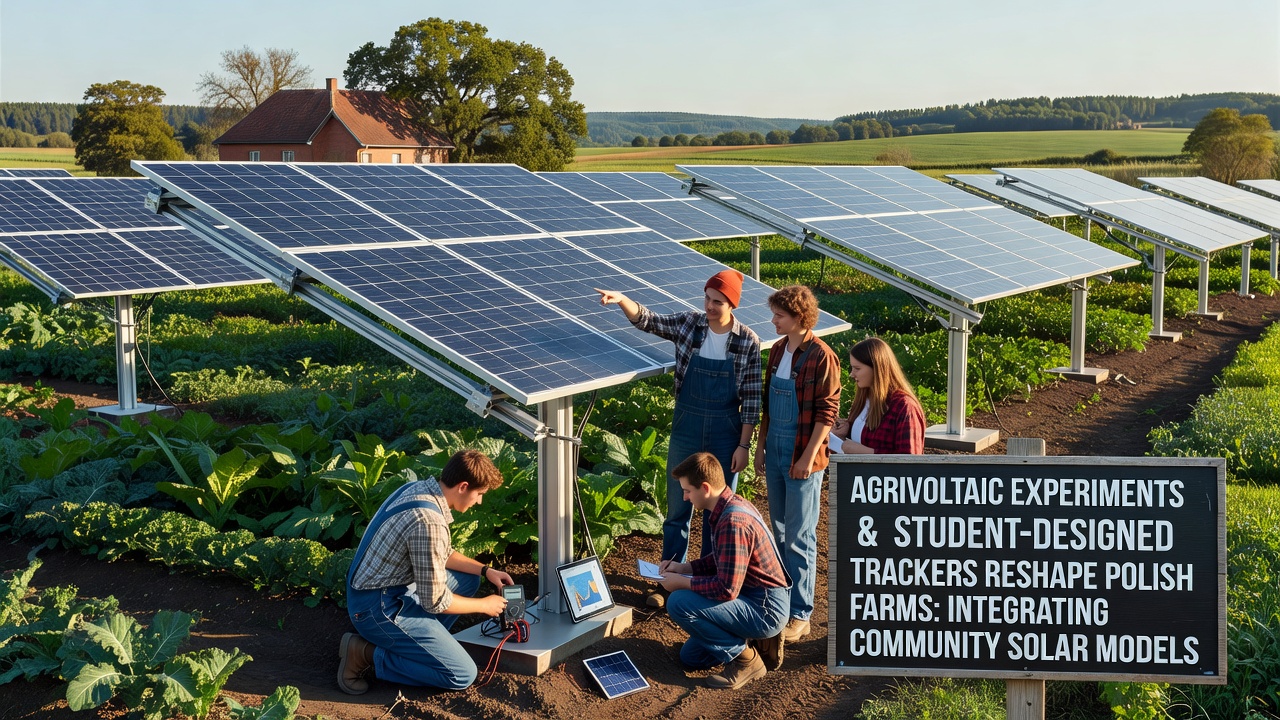
Polish farms have begun testing agrivoltaic systems that combine crop cultivation with elevated solar arrays, while student teams from technical universities design custom tracking mechanisms to optimize panel angles throughout the day. These experiments integrate with community solar models where multiple farms share generation capacity and revenue streams. Data from pilot sites shows crop yields holding steady under partial shade while electricity output rises compared to fixed-tilt installations.
Early Field Trials Reveal Dual Land Use Patterns
Researchers at several Polish agricultural institutes installed elevated racking systems in 2024 and 2025 that allow standard farm equipment to pass beneath the panels. The arrays sit 2.5 to 3.5 meters high, creating microclimates that reduce water evaporation for certain vegetable crops. One installation near Poznań recorded 12 percent higher potato yields in shaded rows during the 2025 season, while adjacent full-sun plots produced the baseline harvest.
Community solar cooperatives in the same region signed agreements allowing neighboring households to purchase shares in the output. Revenue from electricity sales flows back to participating farms after operational costs, creating a secondary income stream that does not require additional land conversion. Figures from the Polish Energy Regulatory Office indicate community solar capacity connected to the grid grew by 28 percent between 2023 and 2025, with agrivoltaic projects accounting for an increasing share of new additions.
Student-Designed Trackers Enter Commercial Testing
Engineering students at Warsaw University of Technology and Wrocław University of Science and Technology developed low-cost single-axis trackers using locally sourced motors and open-source control software. The designs adjust panel tilt every 15 minutes based on real-time irradiance sensors rather than astronomical calculations alone. Early prototypes cost roughly 35 percent less than imported commercial trackers while maintaining 92 percent of the energy gain reported in manufacturer specifications.
Three farms in the Lubelskie region installed student-built trackers in spring 2026. Performance data collected through September 2026 showed average daily output increases of 19 percent compared with fixed systems on the same sites. The trackers require only basic lubrication and sensor calibration twice a year, which farm staff perform without external technicians. Universities retain intellectual property rights but license teh designs to cooperatives at no upfront fee in exchange for anonymized performance data.
Grid Integration and Cooperative Structures
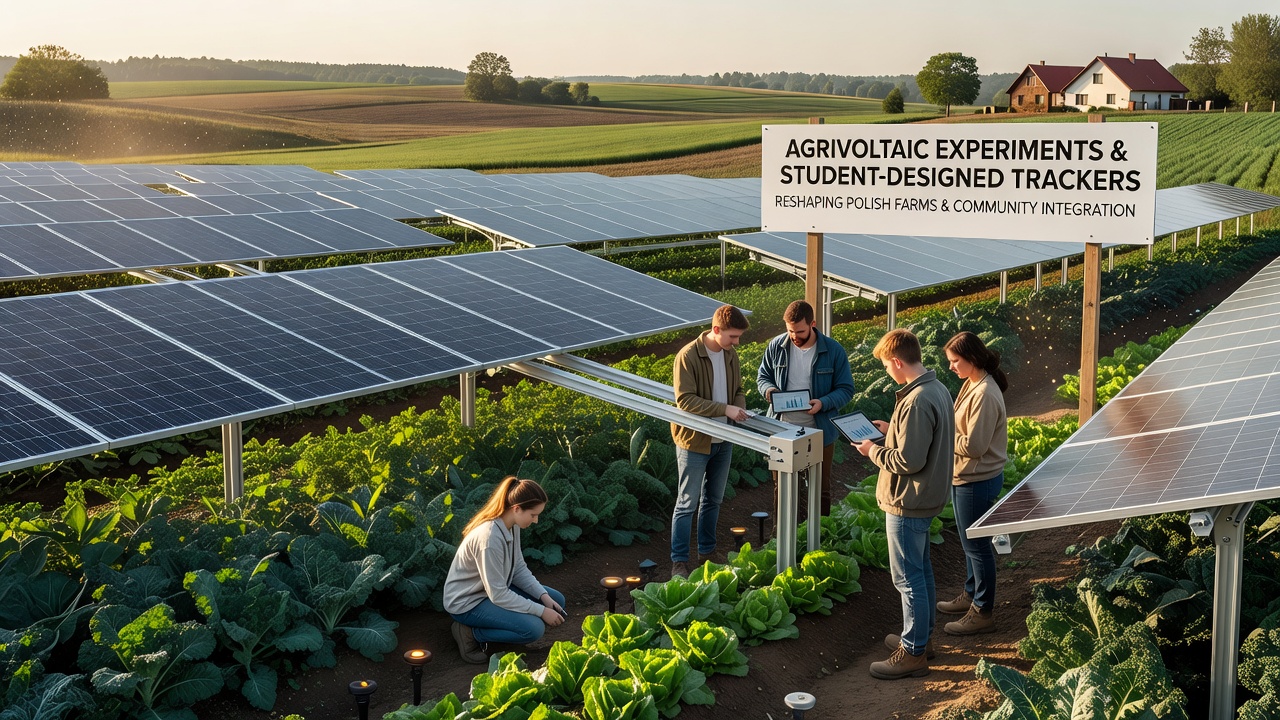
Community solar models in Poland rely on virtual metering that credits members for their proportional share of generation. Agrivoltaic sites add complexity because output varies with both weather and crop growth cycles. Cooperatives now use machine-learning forecasts that combine satellite weather data with ground sensors measuring soil moisture and plant height. These forecasts help schedule maintenance and notify members of expected credit adjustments.
According to a report from the U.S. Department of Energy, similar dual-use projects in the American Midwest achieved 30 to 70 percent greater land-use efficiency than separate solar and farming operations. Polish operators have adapted several of those monitoring protocols while adjusting for local soil types and crop varieties. A separate study coordinated by the Australian Renewable Energy Agency documented comparable yield stability under elevated arrays in wheat-growing regions, providing additional reference data for Polish researchers evaluating cereal crops.
Regulatory Adjustments Support Expanded Deployment
Updates to Poland’s renewable energy auction rules in late 2025 introduced separate bidding categories for agrivoltaic projects under 1 MW. These categories carry adjusted strike prices that account for higher installation costs associated with elevated racking. Grid operators also revised connection procedures to prioritize projects that demonstrate measurable agricultural co-benefits, such as maintained or increased crop output verified by independent agronomists.
By September 2026, eight additional student-designed tracker systems had entered permitting across four voivodeships. Each project pairs with a local cooperative that includes at least five farms and 150 household members. Total installed capacity from these initiatives is projected to reach 4.2 MW once construction finishes in 2027.
Conclusion
Agrivoltaic experiments paired with student-developed tracking technology continue to alter how Polish farms participate in community solar programs. Output gains from the trackers, combined with stable or improved crop performance under elevated panels, support the economic case for shared ownership models. Regulatory changes and data-sharing arrangements between universities and cooperatives have accelerated deployment while keeping costs manageable for smaller operators. Ongoing measurements through the remainder of 2026 and into 2027 will clarify long-term yield trends and grid contribution levels across different soil and crop conditions.