Ines Neumann · 4 October 2026
Polish Weather Archives Unlock Precision Gains for Regional Solar Output Modeling
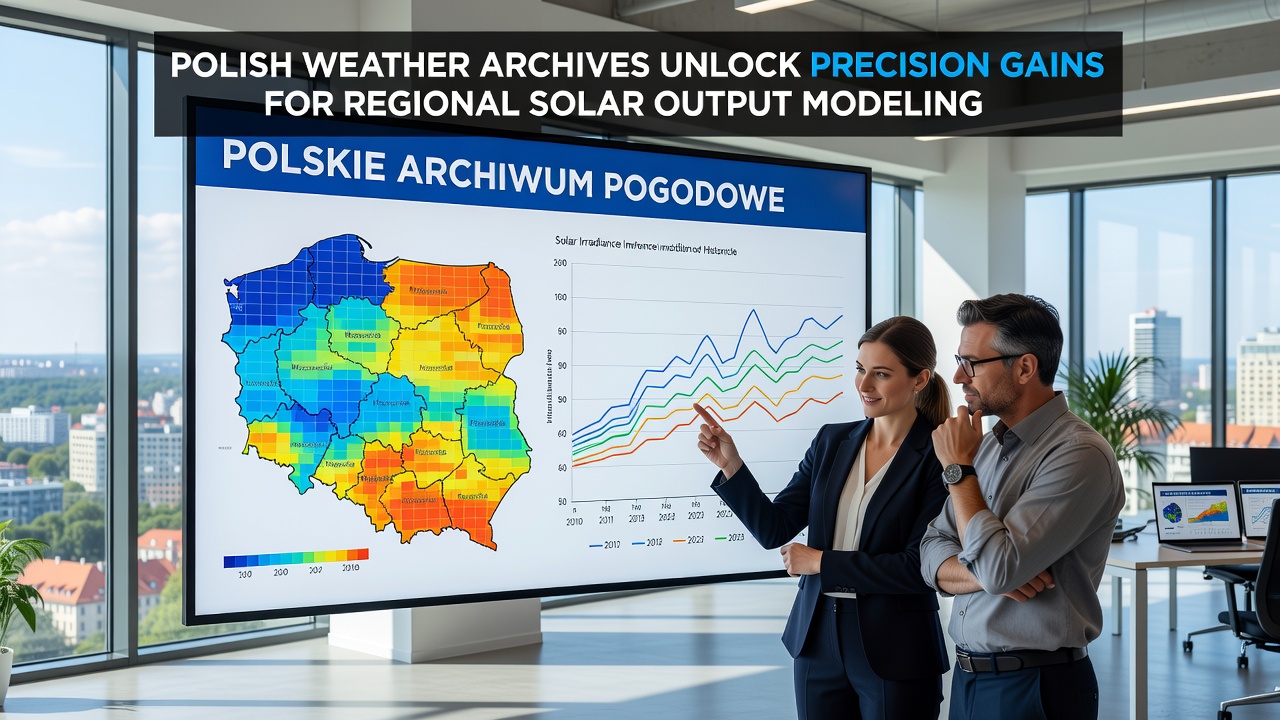
Polish meteorological records spanning decades now feed directly into advanced solar output models, and researchers report measurable improvements in forecast accuracy across multiple regions. Data from the Institute of Meteorology and Water Management supplies irradiance, temperature, and cloud cover readings that refine predictions for photovoltaic installations in both urban and rural zones.
Analysts note that long-term archives allow models to account for seasonal variations specific to Polish latitudes, and these adjustments reduce errors in expected energy yields by noticeable margins. Teams at technical universities integrate the datasets with satellite observations to create localized simulations that reflect microclimates in the Carpathian foothills as well as the Baltic coastal plains.
Archive Sources and Integration Methods
The national weather service maintains digitized records reaching back to the 1950s, and modelers combine these with more recent automated station outputs to establish baseline irradiance patterns. Software platforms ingest hourly and daily values to calibrate algorithms that previously relied on generalized European averages, and the shift produces tighter confidence intervals for daily and monthly generation estimates.
One project completed in late 2025 demonstrated how incorporating ground-level observations from 120 stations across the country improved regional forecasts by aligning simulated cloud persistence with actual historical sequences. Engineers then tested the updated models against operational data from existing solar parks in Greater Poland and Silesia, confirming alignment within single-digit percentage ranges during variable autumn conditions.
Regional Modeling Advances
Regional distinctions matter because northern districts experience different aerosol loads and frontal systems compared with southern highlands, and archives capture these differences over multiple decades. Modelers apply statistical downscaling techniques that translate coarse reanalysis grids into site-specific outputs, and the process relies heavily on verified Polish station records rather than interpolated continental datasets.
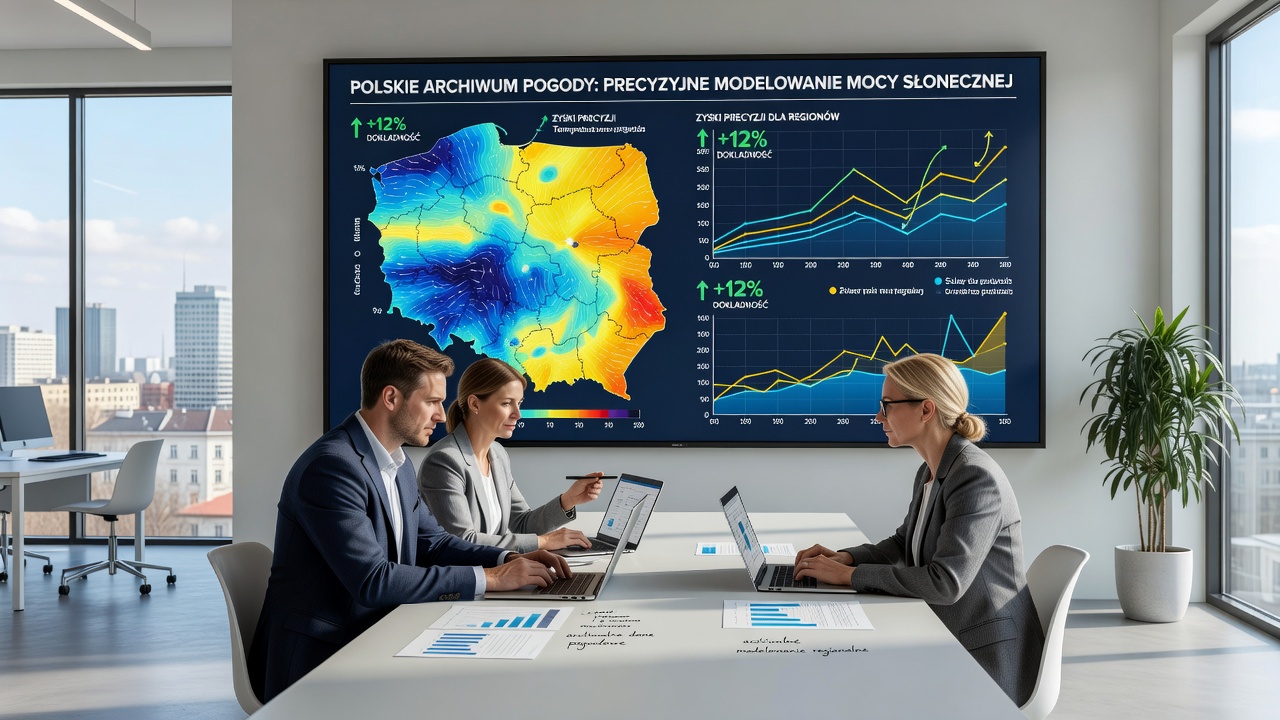
October 2026 saw the release of an expanded archive module covering 2020 through 2025, and developers quickly incorporated the newest five-year block into operational tools used by grid planners. The addition captured several anomalous cloud-cover periods that improved representation of low-irradiance winters, and early validation runs show reduced bias in modeled output for installations above 50 degrees north latitude.
Academic groups publish comparisons showing that models trained solely on archive-augmented inputs outperform those using only reanalysis products, and the difference becomes most evident when simulating performance during prolonged high-pressure systems typical of Polish summers. Grid operators now request these refined projections when evaluating connection applications for new photovoltaic capacity.
Practical Applications in Energy Planning
Transmission system planners use the enhanced outputs to forecast aggregate solar contribution during peak demand windows, and distribution companies apply similar techniques for voltage regulation studies in areas with dense rooftop arrays. The archive-supported models also support scenario work that examines how shifting weather patterns might alter future yields under different emissions pathways.
Industry reports indicate that several Polish solar developers now require archive-validated yield assessments before securing financing, and banks cite improved predictability as a factor in risk calculations. International datasets from the European Centre for Medium-Range Weather Forecasts supplement the national records where gaps exist, while Copernicus Atmosphere Monitoring Service aerosol data adds another layer for high-resolution runs.
Technical Refinements and Validation
Researchers apply machine-learning post-processing to correct systematic deviations that remain after physical modeling, and training datasets draw directly from paired weather observations and measured panel output. Cross-validation across multiple sites confirms that the approach generalizes well when new stations enter the network, and error metrics continue to decline as the archive length grows.
Additional work examines how snow-cover duration and hoar-frost events recorded in the archives affect winter performance estimates, and these factors prove especially relevant for arrays in northeastern provinces. Updated parameterizations now account for albedo changes that older models overlooked, producing more realistic December-to-February generation figures.
Conclusion
Polish weather archives continue to serve as foundational inputs for solar output modeling at regional scales, and ongoing digitization efforts promise further gains in spatial and temporal resolution. Grid integration studies, project financing decisions, and long-term capacity planning all benefit from the improved accuracy that these historical records enable when combined with modern analytical methods.